Showing posts with label Food. Show all posts

Monday, July 9, 2012

PLANTATION LIFE (8) – Cocoa – Malaysia is the World’s 5th largest producer.


  Tenegang – Lahad Datu, Sabah, Malaysia

 Filipino workers preparing polyethylene bags for the seeds

 Filipino workers sowing cocoa seeds in polyethylene bags.

 Cocoa nursery

Shade trees.

   Cocoa is grown in full sun however the young tree
needs shade, especially during its establishment. 


   Flowering and fruiting!


The cocoa tree is a small tree. It produces cocoa pods on its woody trunk and branches. The 20cm long pods are red or yellow and are hard. Cocoa pods are produced throughout the year. Natural Cocoa Powder is made from well-fermented and roasted cocoa beans.


The Cocoa tree's botanical name, 'Theobroma cacao' translated from the Greek means "food of the gods" has a history as far back as 1662.


Cocoa was first introduced to South East Asia in the 17th century by the Spanish and brought to Sabah in the early 18th century. In Malaysia, the first cocoa planted area was found in Malacca in 1778. The earliest cocoa commercialization started between 1853 to 1959, first planted at Jerangau, Terengganu.


The Malaysian cocoa industry started its commercial planting in the early 1950s, experienced a growth that was accelerated by high prices of cocoa in the 1970s and 1980s. The prices of cocoa beans varied greatly over the years due to shortage or over-supply of world cocoa beans. The all time record of the price was in 1977 when it reached RM 13,000 per ton. Malaysia currently is the world’s fifth largest cocoa producer and is the largest cocoa processor in Asia. 


However, due to the persistent low prices which started in early 1990 coupled with extensive labor compared with the oil palm industry, most plantation companies were no longer interested in cocoa cultivation.


Today, cocoa is the most popular and most favoured flavour in the world. For an interesting read on the health benefits/tips/recipes of Cocoa and new research/findings go here .


               Johnny Depp movie  

   Charlie and the Chocolate Factory

Saturday, July 7, 2012

PLANTATION LIFE (7) Oil Palm - Malaysia’s Golden Crop


The palm fruit is naturally reddish in colour because of the high beta-carotene content, the same nutrients that give tomatoes, carrots and other fruits and vegetables their rich colours. It is about the size of a large plum and grows in large bunches.


When ripe, each bunch of fruit weighs 40-50 kilogrammes. Oil palm bears fruit the whole year round, an average plant has an economic life of 25 to 30 years.


The oil palm is an important agricultural crop, which yields three important sources of food, namely palm oil, palm kernel oil and palm kernel cake. While the first two products can be used for human consumption, such as cooking oil, margarines, shortenings, bakery fats, vanaspati, ice creams and Vitamin E, etc., palm kernel cake is used as an animal feed.

 
Palm oil is currently the largest component of the global oils and fats trade and Malaysia continues to feature as one of the largest producers in the world; providing this edible oil for a number of wide-ranging industries in the food and non-food sectors, including recently, supplying renewable energy from its biomass. 


An average of 3.7 tonnes of palm oil, 0.4 tonnes of palm kernel oil and 0.6 tonnes of palm kernel cake is obtainable from one hectare of land. Oil palm occupies less than 5% of the global oil crops planted area and less than 1% of the total agricultural land area in the world.


 “Malaysia's oil palm plantations, which directly employ 580,000 jobs, supports two million livelihoods. Based on the track record in Malaysia and Indonesia, the International Fund for Agricultural Development (Ifad) is funding a project in Uganda to test the effectiveness of oil palm planting as a poverty eradication tool”.


"Planting oil palm trees help alleviate poverty because palm oil can generate returns of about US$3,000 per hectare (RM10,320) while other food crop generates less than US$100 (RM340)"  ..…………Chairman and Founder, World Growth, a former career diplomat also chairman of the national Australian APEC Study Centre, one of Australia's leading economic researcher based at RMIT University, Melbourne.


Interesting updates on the oil palm industry, go here.


Thursday, July 5, 2012

PLANTATION LIFE (6) – Survival - Gifts from Nature


Our temporary home was built on top of a hill, isolated in the middle of nowhere and far enough away from civilization. How do we survive and adapt in times like this? ~~~Enjoy and make full use of the gifts that nature provides.


We depended on rainwater for our daily water consumptions. Water is collected from roof gutter channelled down into an underground storage tank, treated and pumped up into the water tank.


Periods of hot and dry weather would bring serious water shortage... Tankers were sent deep into the jungle to collect spring water from the hills, a slow process which would take hours to fill up just one tank – rationed and distributed to everyone. 


For a refreshing and complete bath the best solution was to take our families into the jungle, find a stream and splash splash splash, like wild animals!


Twenty four hours diesel generators provided electricity for our basic needs, air conditioning and fans, TV, freezers, computers, kitchen and other home electrical appliances including water heaters. In times of breakdowns and the wait to have these generators repaired – revert to kerosene lamps and candles.  


Moonlight is a welcoming relief, helped us move from place to place at night – (the deadly silence and thick heavy mist - very eeeriee to travel at night!).

 Masi and Asma with a basketful of veges from our vegetable plot


Travelling to towns was never easy (rugged, long and tiring journey) and during bad weather, almost impossible. 


We therefore grew our own vegetables; greens, beans, tubers, legumes, roots and herbal plants - just about anything grew well here.


Vegetables like water spinach (kangkong), chillies (cili burung/padi), cekor manis, terung pipit, fern/bamboo  shoots and many others grew wild in the jungle year round.


Besides the many types of veges and herbal plants we also grew melons, pineapples, sweet corns, coconuts, bananas, papayas, etc.


Fresh succulent Asparagus shoots


After work and rest, workers spend their free hours at the vegetable plot; a coordinated community effort (in Malay gotong-royong) and harvests were shared and distributed free for all in the plantation. Plentiful. 

My poor 2nd son just received his haircut - chipped and crafted by his naughty big brother...


During weekends another group of workers would head to the rivers to catch fish and fresh water prawns (using traps), fresh! fresh! fresh - also distributed for free.  


We have security men patrolling the plantation (24hours) mainly to drive away wild animals found venturing in the plantations. There had been reported cases where several acreas of young oil palm trees were destroyed, trampled or uprooted by elephants and wild boars causing a lot of damage.
 

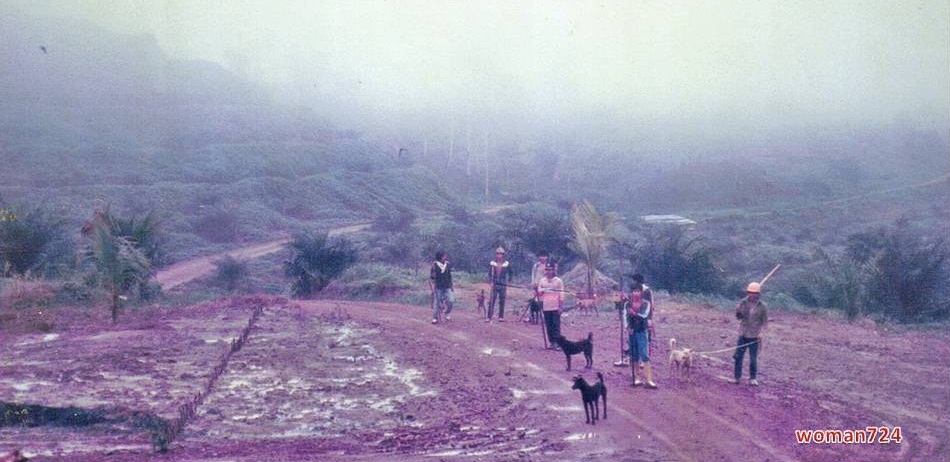
These men move in groups accompanied by hunting dogs. Occasionally they would bring back some wild catch from the jungle - meat shared and also distributed free for all. 


"WHAT A WONDERFUL WORLD"

Remembering Eva Cassidy

Katie Melua & Eva Cassidy 

Friday, June 22, 2012

PLANTATION LIFE (5) Oil Palm - Planting


 Tenegang, Lahad Datu, Sabah, MALAYSIA

Young oil palms transferred out from the nursery
and planted in the palm groves.

  Establishment of leguminous cover plants
immediately following land clearing.


  leguminous cover plants
Dirt road leading to our residence,
a temporary timber bungalow built on top of a hill.


The first oil palm plantation in Malaysia started in 1917 and planted on a large scale in Tennamaram Estate by M. H. Fauconnier. Soon, Alexander Guthrie founded the Guthrie stable of estates and John Middleton Sime teamed up with Henry Darby to establish the Sime Darby group of estates. (Images of plantations in the early 1900’s, here).

Today the largest Palm Oil Company in Malaysia is Synergy Drive Sdn. Bhd. which was formed after merging Golden Hope Plantations Bhd., Sime Darby Bhd. and Kumpulan Guthrie Bhd. Synergy Drive Sdn. Bhd. have more than 500,000 hectares (1,300,000 acres) of Oil Palm Plantation in Malaysia and Indonesia.


Federal Land Development Authority (Felda) is the world's biggest oil palm planter with planted area close to 900,000 hectares in Malaysia and Indonesia. Felda was formed on July 1, 1956 when the Land Development Act came into force with the main aim of eradicating poverty.

Friday, June 8, 2012

PLANTATION LIFE (4) – Oil Palm Nursery

Tenegang, Lahad Datu, Sabah, Malaysia

 Cheerful nursery workers from Sulawesi, Indonesia – Bugis Muslims.


 Young oil palms


Palm oil is now an important energy source widely acknowledged as a versatile and nutritious vegetable oil. Production in Malaysia has increased from only 1.3 million tonnes in 1975, through 4.1 million tonnes in 1985 and 7.8 million tonnes in 1995 to 18.2 million tonnes in 2010/11. 


Malaysia supplies 27.1% of world total palm oil and together with Indonesia, supply over one half of total trade in vegetable oils.


To those who wish to know more of the benefits from this oil and its products, the Malaysian Palm Oil Council (MPOC) provides real time information via their website here.